
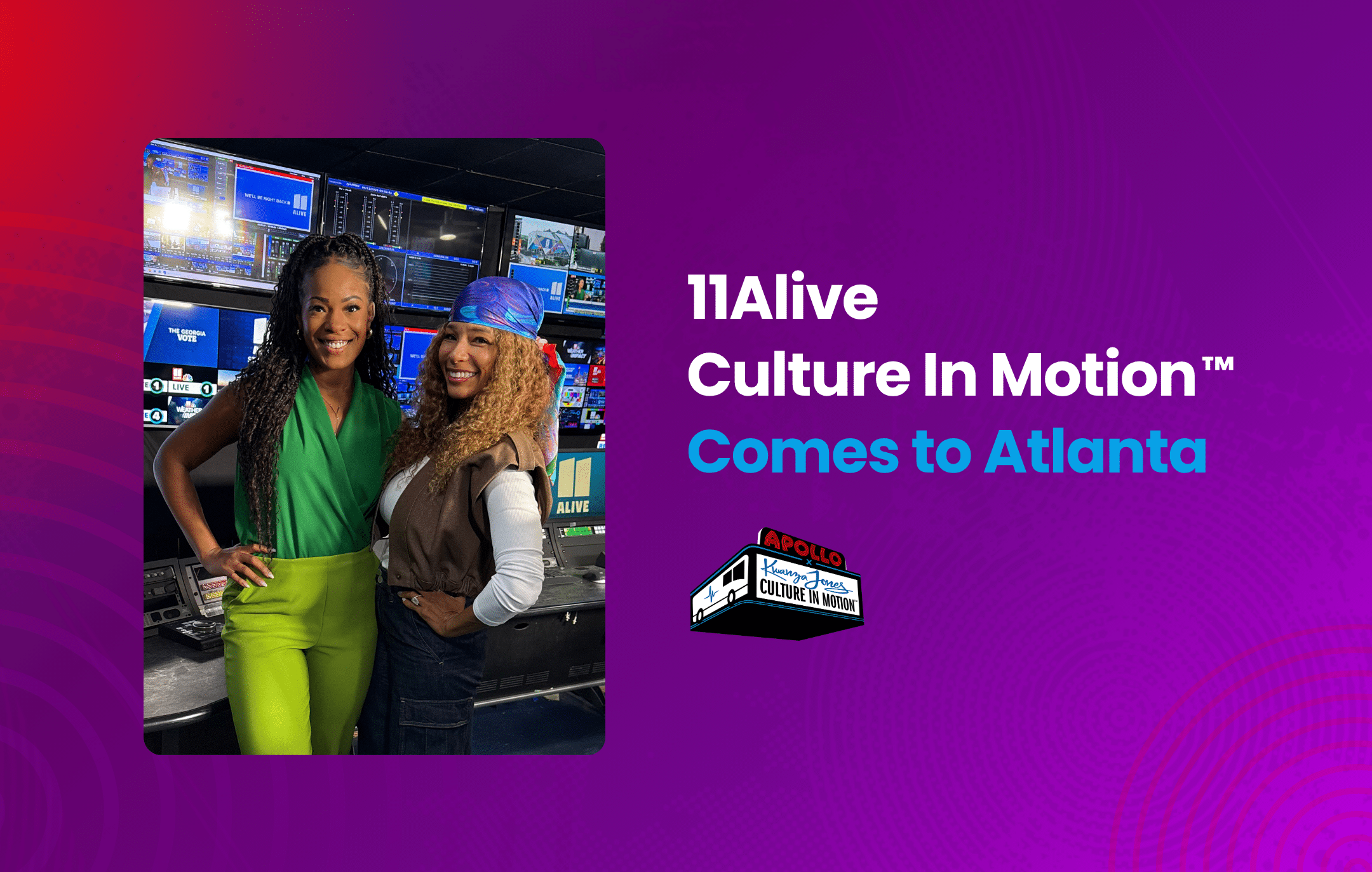
11Alive: Culture In Motion™ Comes to Atlanta
Transcript
Speaker 1 (00:00:00 -> 00:00:08)
So, the National Arts and Empowerment Roadshow is making a stop here in Atlanta, and Culture In Motion™, founded by Ms. Kwanza Jones, is taking part.
Speaker 1 (00:00:08 -> 00:00:15)
And you know what? Ms. Kwanza Jones is joining us right now in the Stream Pod.
Kwanza Jones (00:00:15 -> 00:00:21)
Hello, hello, I am so excited to be in ATL, Atlanta. I hadn’t been here for a couple of years, so I’m excited That Culture In Motion™, Kwanza Jones, with The Apollo is here.
Speaker 1 (00:00:21 -> 00:00:45)
I love it. And I mean, oh my gosh, we had a fabulous woman just on before you who had just all this beautiful energy. You’re bringing even more energy. I mean, it’s a great day to be a Thursday. It’s a great day to be in the Stream Pod.
Kwanza Jones (00:00:36 -> 00:00:45)
Well, thank you. I think it’s because of the hostess with the mostest. The color, the energy, the vibe, it’s here. It’s exactly…
Speaker 1 (00:00:45 -> 00:00:52)
Let’s talk about the event that’s here with SCAD. Tell me a little bit, for those who aren’t familiar, give us a little breakdown.
Kwanza Jones (00:00:52 -> 00:01:32)
OK, so hopefully many are familiar with The Apollo, the world-famous Apollo in Harlem, New York.
Well, here’s a little bit about it. The main stage closed, and it’s the first time in almost 100 years that there’s going to be a major renovation. So what that means is no shows on the main stage, no Amateur Night at The Apollo, none of the things that people are used to having and hearing from The Apollo.
So I said, because I’m on the board of The Apollo, why not take it on the road? Let’s take culture on the road because so many people come from so many places to perform at The Apollo. And I like to think of Culture In Motion™ it’s like The Apollo out in the communities, as a way to say thank you to everyone who comes to The Apollo.
So that’s why we’re here in Atlanta, because Atlanta, as you know, is a major creative hub, cultural institution, and capital, I think, of the U.S., too. It absolutely can be.
Kwanza Jones (00:01:42 -> 00:01:51)
So that’s why we’re here, to just try to partner with the community, bring The Apollo, and have some of Atlanta’s creative spirits and industries all show up. And today we are at SCAD.
Speaker 1 (00:01:54 -> 00:02:03)
That’s right, that’s right. No, and you were in my head because I was just about to say, tell me about that partnership because we have some extremely talented students at SCAD. Tell me about that partnership and why you picked SCAD as the location.
Kwanza Jones (00:02:03 -> 00:03:17)
So SCAD is one of our first stops here in Atlanta. We’re also going to be doing some things at Spelman and at Morehouse a little bit later. There is on June 19th, Juneteenth, there’s a Juneteenth parade here in Atlanta.
So we’re going to be here. The Culture In Motion™, Apollo, and Kwanza Jones Roadshow, the National Arts, and, most importantly, Empowerment. The Empowerment Roadshow, too, is going to be here for about a week, but only in different places.
Why we chose SCAD as a kickoff place for Atlanta is that it embodies creativity. It embodies arts and the diversity of arts that are there, whether it’s visual arts, whether it’s music arts. They’re going to have recording things that are starting too. So it was a literal campus where we were able to drive in, touch down, and open up the stage and the doors.
So today there are going to be people who are doing performances similar to an Amateur Night performance. Some people are used to getting shooed off the stage, but this is all about love this time. It’s all about love because this is letting folks know that The Apollo is here.
So after we do SCAD, then we have a few other stops we’re going to be doing in Atlanta, too.
Speaker 1 (00:03:17 -> 00:03:19)
And tell us about it.
Kwanza Jones (00:03:19 -> 00:04:31)
All right, so let me tell you. Last night at SCAD, we had the opening event, and it was a Culture and Convo conversation, and we worked with a nonprofit organization here.
I don’t know if you’ve heard of it, but it’s called Nsoro. And Nsoro, actually, I was one of Nsoro’s… I call myself the queen of energy, as do a lot of other people.
Speaker 1 (00:03:43 -> 00:03:44)
I love it. That’s perfect.
Kwanza Jones (00:03:44 -> 00:04:31)
But Nsoro has something every year called the Starfish Ball, and I was the queen of the ball a few years ago. And we partnered with Nsoro, which does a lot of work for students and kids who are in the foster care system and don’t have the services or the wrap around support that so many of us just take for granted.
That we have places to live, supportive family, supportive homes, supportive communities. Nsoro provides that. So what we did at SCAD last night was have an Nsoro and Culture and Conversation talk, talking about how communities, how arts, how creativity can all come together and help boost others.
And that’s why we chose SCAD, because SCAD boosts students, it boosts communities, as does Nsoro, and Apollo that has always been a beacon, does that too.
Speaker 1 (00:04:32 -> 00:05:15)
Absolutely, absolutely. And for those who are watching, obviously it’s an Atlanta audience, but many of us have been to Harlem. I actually used to live in New York.
Speaker 1 (00:04:39 -> 00:04:39)
I did. I did only a couple of years. I’m from here.
Speaker 1 (00:04:39 -> 00:05:15)
But that is when you hear about The Apollo, it’s iconic. And I want to ask you because you have the whole Harlem Renaissance, you have The Apollo, but then you come down to Atlanta and it’s almost on the movie side, kind of the Hollywood of the South.
But a lot of those actors come from theater or are looking to go back to theater, right? And then a lot of the stage plays are coming down. So I wonder, my question to you really is, what is that relationship between the Atlanta arts scene and the Harlem arts scene and that bridge?
Kwanza Jones (00:05:15 -> 00:06:46)
Well, it’s fascinating because yesterday I was doing a podcast with T.I. So talk about someone who embodies so many different types of artistic expression. And The Apollo having music, for example. And I love that you asked the question because not a lot of folks are aware that The Apollo has theater, too.
So The Apollo has a 99-seat theater that’s one of their smaller theaters called the Victoria.
So when we think about combining the arts, the entertainment, the Southern media capital, if you will, which Atlanta is, and the relationship to The Apollo, what happens is we’re able to have so many of these cities and communities, Atlanta being a big one, that are feeders, if you will, to that iconic stage. But not feeders as in, “Oh, OK, Apollo is just taking things from the community.”
More so that Apollo is going and showing that you can have expressions that are oftentimes localized expressions of culture because culture in Atlanta may be different than culture in New Orleans, may be different than culture in the DMV area.
All of it is culture, but how you go and show up for it is what The Apollo does, and it brings it all together.
So to me, the relationship really is about how do we continue to identify pipelines and create opportunities beyond local communities, too, for folks to have literal platforms and literal stages, and The Apollo being one of those that has just been such an iconic stage throughout almost a century.
Speaker 1 (00:06:47 -> 00:07:04)
Yeah, absolutely. I mean, you can name the names that have come through and performed at The Apollo. Let me ask you this, too, because obviously it’s a new generation. We have streaming, we have the emergence of AI music, you have all of these different things that are happening.
How is The Apollo, which will forever be an iconic name, but how is the team there staying relevant, staying up front and bringing in that new generation?
Kwanza Jones (00:07:12 -> 00:09:05)
Have you been in our board meetings? OK, for all our Apollo folks, she’s not on the board. She might need to be on the board. Come on now. Have you been in them?
Those are the conversations that we have, and also that the leadership of The Apollo has. We have these conversations so often. And I will say that’s one of the reasons why the main stage is closed for renovation, to make sure that we are able to stay in pace and keep up with what is happening now.
Because yes, as you mentioned, it’s iconic. It’s always going to be there. But the goal is, and that’s why Culture In Motion™ is here, the goal is not to think of The Apollo as a place of solely heritage or a place of solely what has been. But instead, to continue to have The Apollo be a place of what can be and what possibility is.
Because the fact that some folks know, not everyone knows, like folks know about American Idol know or they know about AGT America’s Got Talent, all of those sorts of shows, Not everyone knows that Showtime at The Apollo was one of the ones that started it all.
Speaker 1 (00:08:12 -> 00:08:14)
That was the footprint.
Kwanza Jones (00:08:15 -> 00:08:23)
Exactly. That literally was a model of how to go in and have a footprint and blueprint. It left a footprint.
Speaker 1 (00:08:24 -> 00:08:25)
There you go.
Kwanza Jones (00:08:26 -> 00:08:58)
It left a footprint that others were able to then go in and say, “Oh, I’m just going to step into this, and I’m going to expand it here, or I’m going to expand it there.” But that foundation, that footprint, and also that blueprint is what others followed.
So that’s what we’re trying to do even with AI. That’s what we’re trying to do with technology. That’s what we’re trying to do to continue to make sure that in a time and age where there is streaming, even here, you’ve got all of your followers and your viewers and your audience. They’re on YouTube, they’re watching all of this, and they can access you 24/7.
Not just during, “OK, this hour to this hour.” Anytime you want, you’re available to do that. So we’ve been having the conversations.
Speaker 1 (00:08:58 -> 00:09:05)
Have you been in our board meetings?
Kwanza Jones (00:09:05 -> 00:09:09)
I don’t know, maybe I need to be.
Speaker 1 (00:09:09 -> 00:09:11)
I’m not either, but I just, I get, I get the, the, the trickle down. But no, I mean, it’s so relevant. It is so relevant.
Kwanza Jones (00:09:14 -> 00:10:08)
And I think if we all, not only as a community but as a society, are not thinking about that… And that was part of the conversation we had last night in the Culture and Convo talks at SCAD.
If we’re not thinking about it, it’s not about, “OK, how do we run and how do we hide from it?” Instead, it’s about how do we embrace it. And by embracing it means we need to learn about it, we need to study it, we need students understanding it.
We even need folks who are no longer students in school to always have an open mind about, “Huh, now if there’s AI music, guess what? That’s not the same as a live performance, but how do I incorporate some of those things if I want to incorporate them? Or how do I have a panel or a conversation about those things?”
Because platforms, again, like The Apollo and like so many places even here in Atlanta, give a literal stage for people to have the conversations and, most importantly, to be part of creating what comes next.
Speaker 1 (00:10:09 -> 00:10:30)
There you go. That is the point, creating the future. Oh my goodness, I could talk to you all day. I’m going to have to come up to New York and see you.
Kwanza Jones (00:10:16 -> 00:10:17)
I’m in L.A., too. So come up there.
Speaker 1 (00:10:18 -> 00:10:26)
There we go. I’m going to call you up and come. But before we wrap up, just to reiterate for those who are watching, how can we find out about the events? Where can we go
I’m sure you all have a landing page, Instagram…
Kwanza Jones (00:10:30 -> 00:11:31)
… all of it, all of it, all of it. So one of the things with Culture In Motion™, and I’m Kwanza Jones, and my husband and I, Kwanza Jones and José E. Feliciano, through our Kwanza Jones & José E. Feliciano Initiative, we are underwriting this entire tour because we understand that arts, culture, empowerment, and community is so important.
So it’s what I call giving a boost to humans and humanity and to the culture. So with that in mind, you can go to BoostBus.com. That’s B-O-O-S-T-B-U-S dot com, because it’s a bus. Get on the bus.
And then on Instagram, you can go to BoostBusOfficial.
And you will find all the places that we’ll be because we’ve been in L.A., we’ve been in D.C., we’ve been in Norfolk, we’ve been in Atlanta, we’re going to Tennessee, we’re going to New York, we’re going to Detroit, we’re going to Miami.
Yes, the roadshow is on the road. The roadshow is literally in motion.
Speaker 1 (00:11:31 -> 00:11:41)
I love it. Boost Bus. OK, we’re getting on the bus. I’m hopping on the bus. I’m going to grab a couple of bus tickets.
Ms. Kwanza Jones, thank you so much for coming in. It was so great to see you and just all this energy. I’m taking this energy with me through the weekend, guys. BoostBus.com.
We’ll put some more information on 11Alive.com.